For most of software's history, interfaces were designed to make capabilities visible. Buttons showed people what they could click. Menus showed them where they could go. Forms made clear what information a product needed.
AI changed that. Search, commerce, copilots, assistants, and agents are all converging on the same interface: a single empty text box that can theoretically do almost anything.
That text box is extraordinarily powerful. But it has a fundamental problem: it doesn't show the user anything.
A blank box cannot explain everything the product is capable of doing. It cannot tell someone which details matter, what information is required, or what they should say next. It gives people access to an enormously capable system while hiding almost all of that capability behind a blinking cursor.
We call this the blank text box problem.

AI Autocomplete solves it in real time. As someone types, it reveals what the product can do, surfaces the most useful next choices, and gathers the information required to complete the action. The result is a faster experience, dramatically better input, and up to 30% more sales from search.
If your product has a search box, assistant, or agent, you can add AI Autocomplete in minutes at AI-Autocomplete.com.
Every product is becoming a text box
The product may know how to do almost anything. The user still has to know what to ask.
A shopping product can help someone find and buy nearly anything. A coding agent can build an application. A travel assistant can organize an entire trip. A search product can understand questions that would once have required a complex set of filters.
But the interface still begins by asking the user to supply a perfect prompt.
Most people do not. A shopper types “shoes” when they actually mean black Nike running shoes, under $150, available in their size, and deliverable before Friday. A user asks an agent to “build a running app,” leaving out authentication, notifications, habit tracking, integrations, and design preferences.
The product is capable of producing a great result. The request simply does not contain enough information.
Users then receive a mediocre result and assume that is the limit of the technology. Assistants compensate by asking round after round of follow-up questions, turning what should feel instant into an interrogation.
Teams often treat this as a model problem. Frequently, it is an input problem.
Every AI product we studied had the same gap: the model was brilliant, but the text box told the user nothing. Closing that gap is the whole product.
AI Autocomplete doesn't complete sentences. It completes intent.
As the user types, the text box reveals the choices that matter next.
Consider a purchase from start to finish. Someone begins with “Buy.” AI Autocomplete can immediately surface product categories. After they choose sports shoes, it can suggest color, brand, model, price, delivery, and payment options, all drawn from the product's real data.
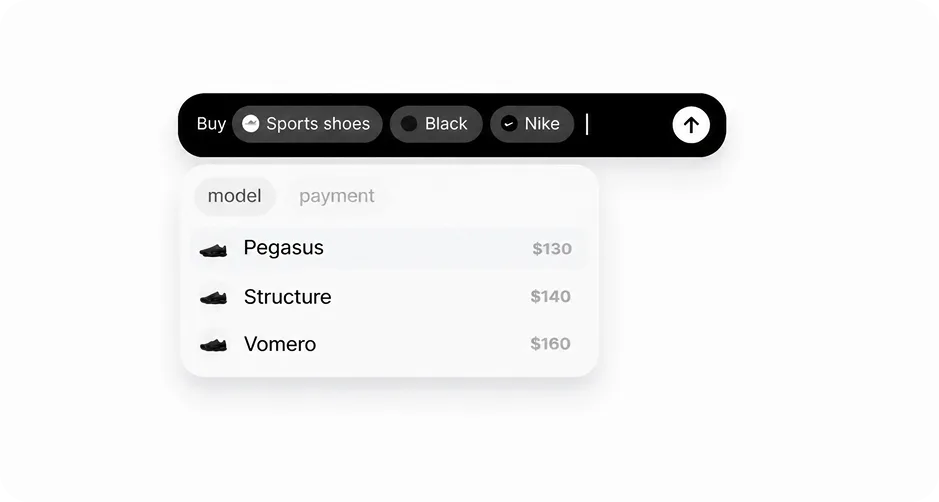
The text box gradually becomes more precise:
Buy → sports shoes → black → Nike → Pegasus → under $150 → pay with PayPal.
The user does not have to study a complicated filter panel or know which information will improve the result. The interface reveals the right choices at exactly the moment they become relevant.
Every selection is also captured as structured data: category, color, brand, model, budget, size, payment method, and any other parameter the product needs. The experience feels natural to the user, while the backend receives clean, actionable input.
The user feels guided. The product no longer has to guess.

Better input changes the economics of search
Most search products spend enormous effort trying to infer intent from tiny amounts of information.
A user types “shoes,” and the search system has to determine whether they want running shoes or formal shoes, men's or women's, black or white, inexpensive or premium. Ranking systems, recommendation models, and retrieval infrastructure are then asked to compensate for everything the user did not say.
AI Autocomplete reverses that process.
Instead of forcing the search engine to guess every missing detail, it helps the user provide those details naturally while typing. A three-word search becomes a rich, structured query without requiring the user to complete a traditional form.
Richer queries produce more relevant results. More relevant results make it easier for users to find what they want. And when people can see the available options before submitting, they are far less likely to reach a dead end.
That is why improving the input layer can produce such a large conversion lift without changing the underlying search engine or model.
Agents should get the complete brief before they begin
The same problem is even more pronounced for assistants and agents.
Agents can now perform remarkably complex work, but their output is only as good as the request they receive. An under-specified instruction forces the agent either to make assumptions or to stop and ask questions.
AI Autocomplete gathers those decisions while the user is still composing the request.
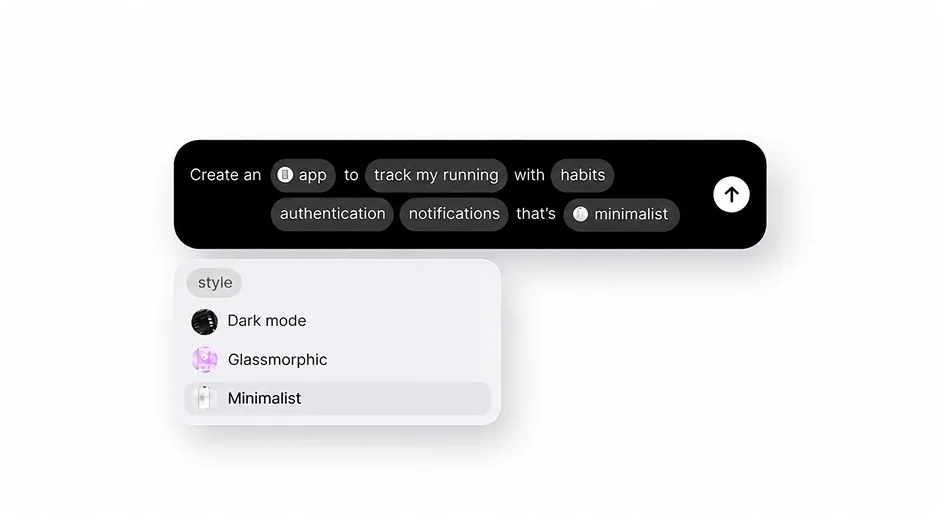
A person typing “Create an app to track my running” can be prompted to add habits, authentication, notifications, integrations, and a visual style. By the time they press Enter, the agent is no longer working from a one-sentence idea. It has a complete brief.
What previously required five or ten exchanges can happen in one pass.
This makes agents feel dramatically faster even when the underlying model has not changed. The agent spends less time gathering requirements, the user spends less time answering follow-up questions, and the first result is much closer to what the user actually wanted.
This is the missing intent layer
AI Autocomplete is not another chatbot.
It is an intent layer that sits between the user and the product.
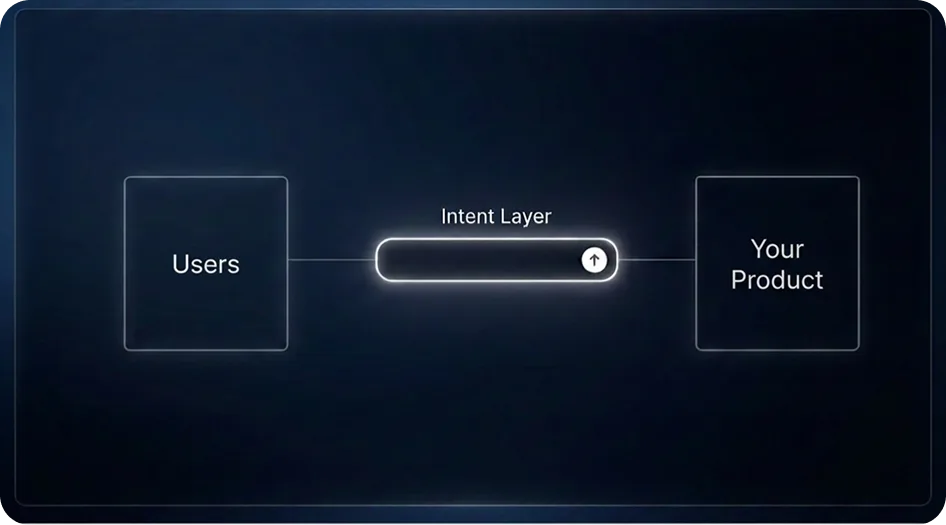
On one side is a person expressing an incomplete idea in ordinary language. On the other is a product that needs specific, structured information before it can search, recommend, create, or act.
AI Autocomplete translates between the two in real time.
It helps users discover everything the product can do. It helps them communicate their needs without learning the product's internal language. And it gives the product a precise representation of the user's intent before the action begins.
In many ways, it combines the best parts of a form and a conversation.
Forms collect structured information, but they are rigid and force every user through the same sequence. Conversations are flexible, but they can be slow and require repeated clarification.
AI Autocomplete creates a form dynamically inside the text box, based on what the user is trying to accomplish. The interface unfolds as the intent becomes clearer.
That is what AI interfaces have been missing.
Built to run inside real products
A feature like this only works if it feels immediate and native.
AI Autocomplete is purpose-built for real-time suggestions rather than general-purpose conversation. It responds much faster and at a lower cost than a traditional LLM call, making continuous, per-keystroke guidance practical at scale.
Per-keystroke guidance only works if it feels instant. We rebuilt the serving path until suggestions came back much faster and cheaper than a standard LLM call.
Developers can configure their product logic and add the SDK to a text box in minutes, and the documentation walks through the setup. Teams can connect their own data, including product catalogs, prices, inventory, available actions, and custom fields, so every suggestion reflects what the product can actually offer at that moment.
The SDK had one design goal: drop it into a text box you already have and watch suggestions show up the same afternoon.
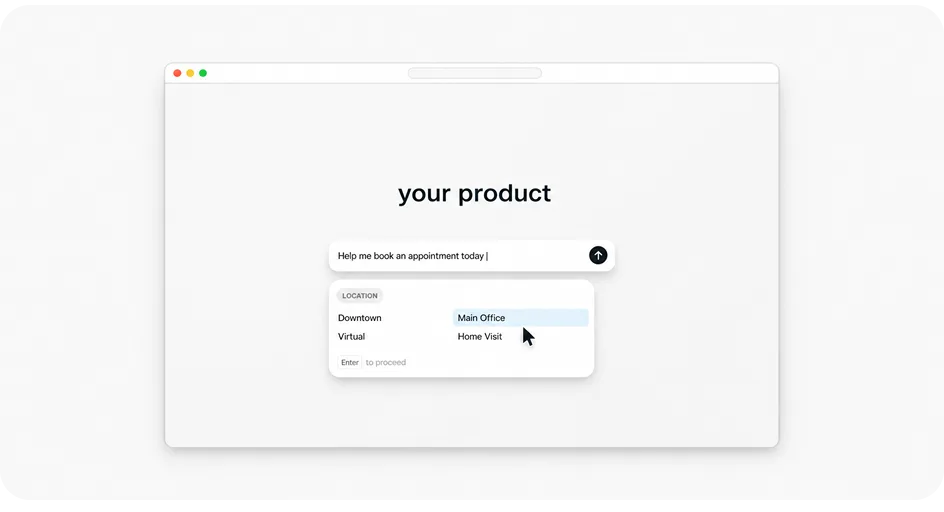
The interface is fully customizable, so the experience can look and feel native to any product. Teams that prefer to build their own interface can use the API directly. The frontend component layer is also being open sourced.
Suggestions have to feel native to your product, down to the pixel. Most users should never realize an SDK is involved at all.
AI Autocomplete is designed for enterprise requirements as well, including custom logic, privacy controls, private deployments, and self-hosting options.
Companies signed up before launch
Companies started signing up to use AI Autocomplete before we publicly released it.
The interest spans commerce, productivity, media, search, software development, customer service, and AI agents. The products are different, but the problem is the same: a text box stands between the user and the outcome, and too much of the product's value remains invisible inside it.
The interface for AI cannot remain an empty rectangle that asks users to figure everything out themselves.
As AI products become more powerful, helping people communicate with them becomes more, not less, important.
The next generation of products will not simply wait for users to provide perfect prompts. They will help people form better requests, expose the choices available to them, and gather the information required to take action.
That is the future we are building with AI Autocomplete.
Give your text box a brain
AI Autocomplete is available today. Add it to your search box, assistant, or agent in under five minutes, and start showing users everything your product can do, as they type.
Try it at AI-Autocomplete.com